
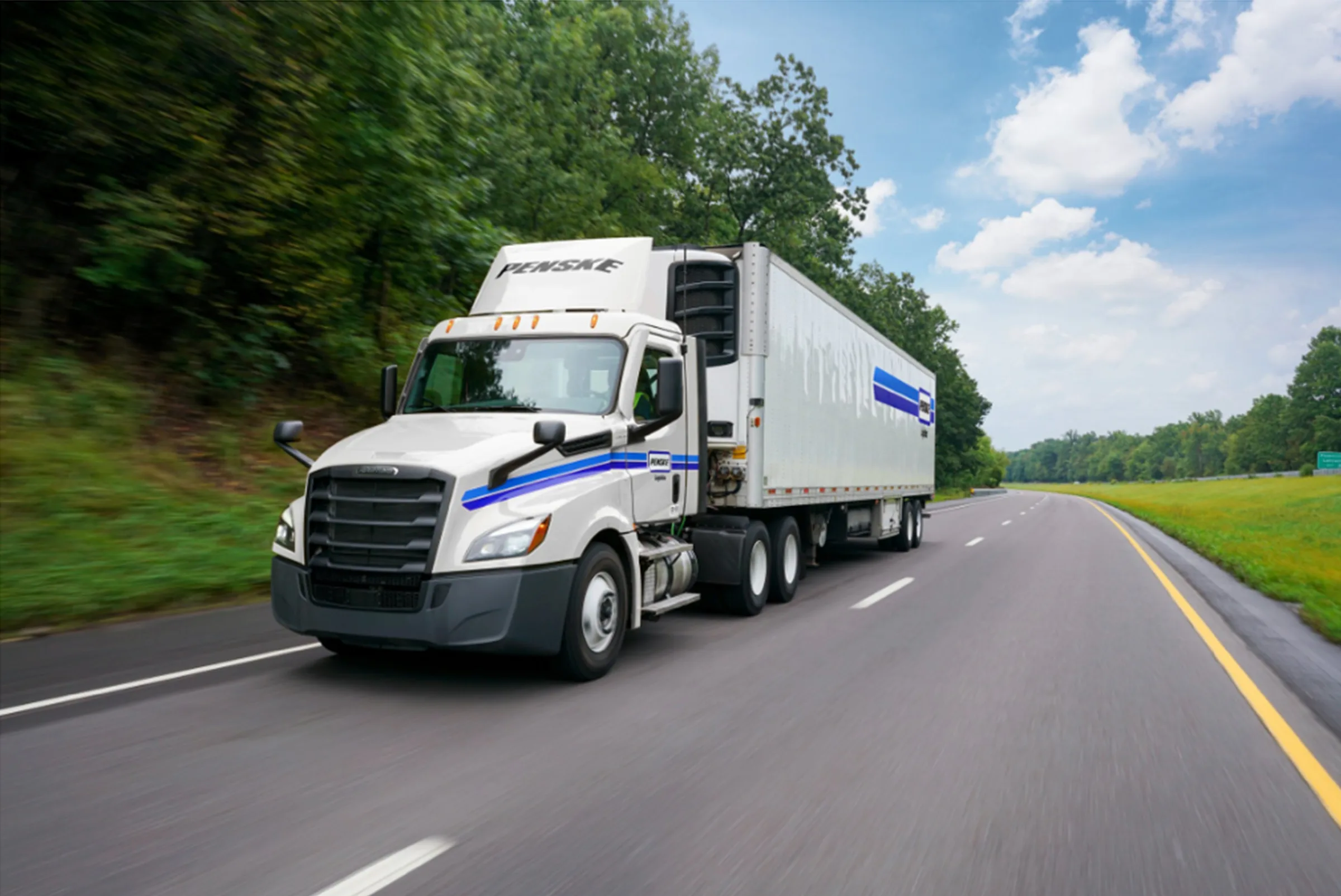
Bridgestone Americas and Penske Transportation Solutions set out to prove which near-term CO₂ reduction measures actually work in live US fleet operations. Dynamon supported their Decarbonization Lab by integrating Penske telematics into Bridgestone’s Big Fleet data analytics platform, then designing an optimised real-world trial so fuel and emissions changes could be attributed to the interventions — tyre choices and renewable diesel — rather than to weather, terrain or day-to-day operational noise.
In partnership with

Watch the Decarbonization Lab video
Key outcomes
- 500,000+ fleet miles analysed in the first phase of the Bridgestone–Penske Decarbonization Lab, with Dynamon as the advanced data analytics partner.
- 6.35% mpg improvement measured when low-rolling-resistance retreads, Bridgestone casings and IntelliTire™ pressure monitoring were deployed on Penske trucks.
- Precision trial design so real-world fuel changes from tyre strategy and renewable diesel could be attributed to the intervention with confidence, mitigating external operational factors.
The challenge
Bridgestone and Penske needed evidence for commercially viable, near-term CO₂ reduction measures that work in live US fleet operations.
The difficulty is measurement. In live fleet work, fuel consumption moves with payload, weather, topography, traffic and driver behaviour. Without a carefully designed trial, a change in mpg can look like a tyre or fuel win when it is really an operational artefact — or a genuine saving can be drowned out by noise.
The Decarbonization Lab therefore needed more than hardware swaps. It needed data integration across Bridgestone’s analytics estate and Penske’s fleet telematics, plus a trial structure that kept external factors under control so results could stand up to scrutiny.
The approach
Dynamon integrated data from Penske’s telematics provider into Bridgestone’s Big Fleet data analytics platform, giving the Lab a shared operational picture of Penske Truck Leasing fleet activity in the United States.
On that foundation, Dynamon used Precision Trial Analytics to design an optimised real-world trial. Historic telematics shaped test and control groups; live monitoring through the trial helped ensure measured fuel changes tracked the intervention rather than diverted journeys, weather swings or other operational variability.
That discipline mattered for every workstream the Lab set out to validate: different tyre and retread strategies, renewable diesel as a drop-in fuel, and the confidence to report CO₂ and efficiency results that partners and customers could trust.
What the Lab tested
The first phase focused on three near-term levers for fleet CO₂ reduction under real-world conditions.
- Tyres and retreads — low-rolling-resistance retreads, Bridgestone tyre casings and IntelliTire™ pressure monitoring on Penske trucks, to quantify the fuel-efficiency impact of tyre strategy in operation.
- Renewable diesel — a drop-in fuel trial in Tennessee, outside Low Carbon Fuel Standard states such as California and Oregon, to test deployment feasibility and study longer-term maintenance and efficiency effects in the Penske fleet.
- Route optimisation and logistics efficiency — Penske and Bridgestone teams worked to optimise Bridgestone’s automotive tyre retail distribution network, projecting roughly 152,000 fewer miles; scaled across the dedicated fleet, that equates to an estimated 4–6% CO₂ reduction.
The results
Across more than 500,000 fleet miles in phase one, the Lab reported a 6.35% improvement in miles per gallon from the tyre and retread package on Penske trucks — a result grounded in disciplined data collection rather than anecdote.
The renewable diesel evaluation moved the conversation beyond well-known emissions factors into operational reality: how the fuel behaves in a major US fleet market without LCFS incentives, and what that means for maintenance and efficiency over time.
Together, the partners showed that combining proven technologies with rigorous trial design and shared analytics can unlock measurable CO₂ reductions and operational cost savings — and that no single company can deliver that alone.
Dynamon’s role was to make the measurement as trustworthy as the collaboration: integrate Penske telematics into Big Fleet, design the precision trial, and help Bridgestone and Penske attribute real-world fuel changes to the interventions they chose to test. A second phase of the Decarbonization Lab is planned to refine the approach and trial further solutions.