
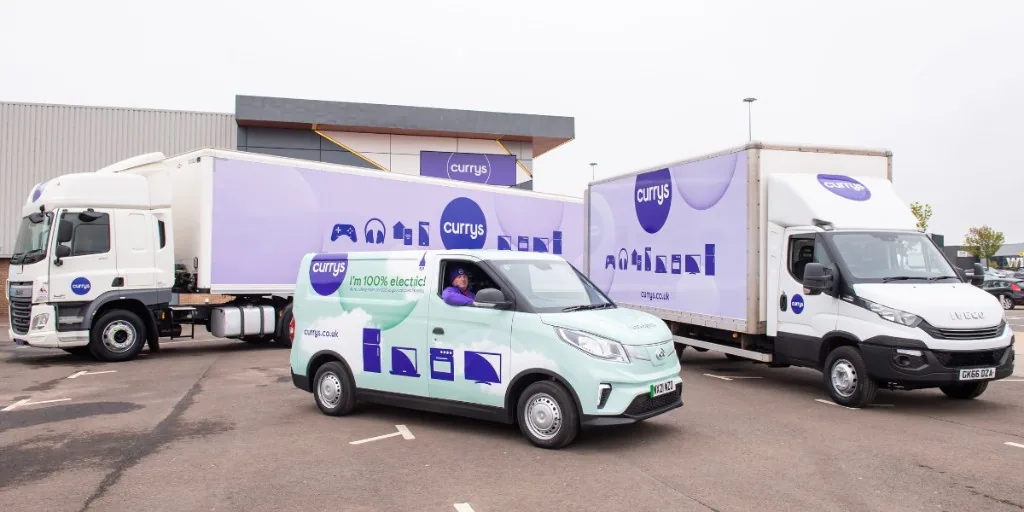
Currys needed to know which rounds from its customer service centres could move to electric vehicles, and what charging each centre would need, before the fleet was committed. ZERO tested a year of operation across 22 centres.
Customer

Powered by

Key outcomes
- 842 vehicles 361 at 3.5 tonnes and 481 at 7.2 tonnes, based at 22 customer service centres across the UK.
- A year of routes Telematics where Currys had it, and the company’s own route history where it did not.
- Battery size decided the heavier rounds. A larger pack covered far more of that work. Faster charging at the centre did not.
The fleet
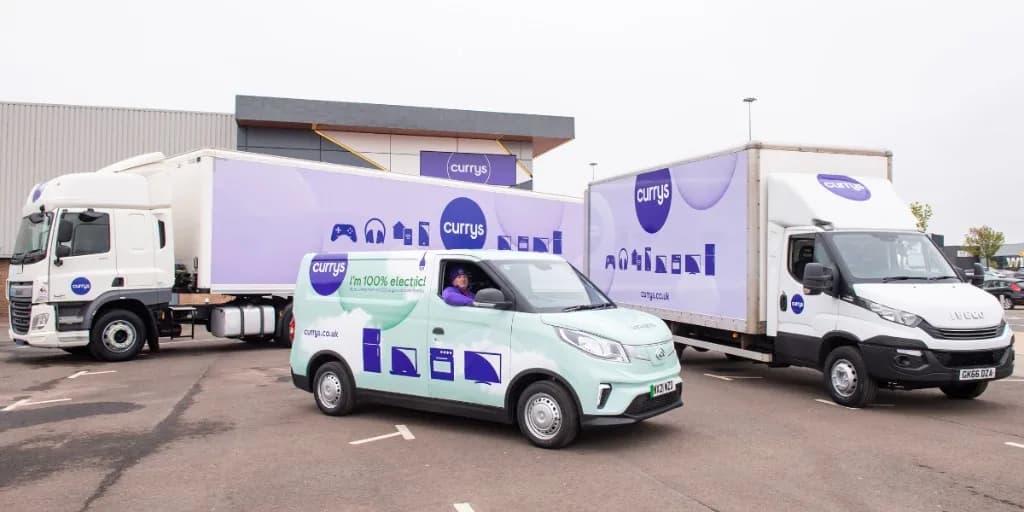
The study covers the commercial vehicles based at Currys’ customer service centres: 842 in total, 361 vans at 3.5 tonnes and 481 trucks at 7.2 tonnes. Most duty cycles are in the region of 100 miles. Some centres run shorter, and some rounds are much longer.
Vehicles move between centres through the year, so each route was counted at the site it left from. Where a telematics history existed, ZERO used it. For the rest of the fleet, Currys’ route history stood in for that driving.
The approach
The study was set up for a phased change, with electric vehicles joining the fleet and diesel kept for the rounds they cannot finish. Each centre was assessed on how much of the work is feasible, which rounds an electric vehicle should be given, and what charging the site needs.
Light vehicles were tested on one battery size. Heavier vehicles were tested on that battery and on a larger pack. A further run asked whether the lighter van could cover the heavier work, where the payload allows. Results are for winter conditions, when range is shortest, and depot charging was tested from a slow supply up to a fast charger.
What ZERO found
Most of the 3.5-tonne work is in range of a modest battery and ordinary depot charging. That is true at the great majority of centres. A few centres with longer rounds are the exception.
On the 7.2-tonne vehicles, battery size is what changes the result. The larger pack covers substantially more of the work. At some centres that is almost the whole operation. At others the longest rounds stay out of range, and a faster charger at the depot does not finish them.
Charging that is too slow to refill the larger battery overnight does leave some of those heavier rounds short. A standard depot charger recovers them. Going on to a fast charger adds very little.
Where the payload allows, replacing the heavier vehicles with the electric van brings much of that work into the same range as the light vans. The longest rounds remain, and it can mean more vehicles on the road.
Scheduling and charging
In a mixed fleet the electric vehicles have to be given rounds they can finish. Mileage is a useful first rule, and it is not a complete one. At many centres the rounds that can and cannot be finished overlap in distance. A longer shift is not the same thing as a round that runs out of charge.
A centre also cannot replace every vehicle and keep them all busy. Suitable rounds vary through the week, so the number of electric vehicles that can be used every day follows the quieter days.
Charging was planned overnight at the centre. Most vehicles are served by a standard charger. A fast charger is only for the few that would not otherwise be full before they leave, and many centres need none. Each site has a power profile through the day, so the connection follows vehicles coming back rather than every charger running at once.
Most of the 3.5-tonne work can move to a modest battery and ordinary charging at the service centre. The heavier vehicles need a larger battery, and the longest rounds stay on diesel until the round itself changes. A faster charger at the depot does not close that gap.