
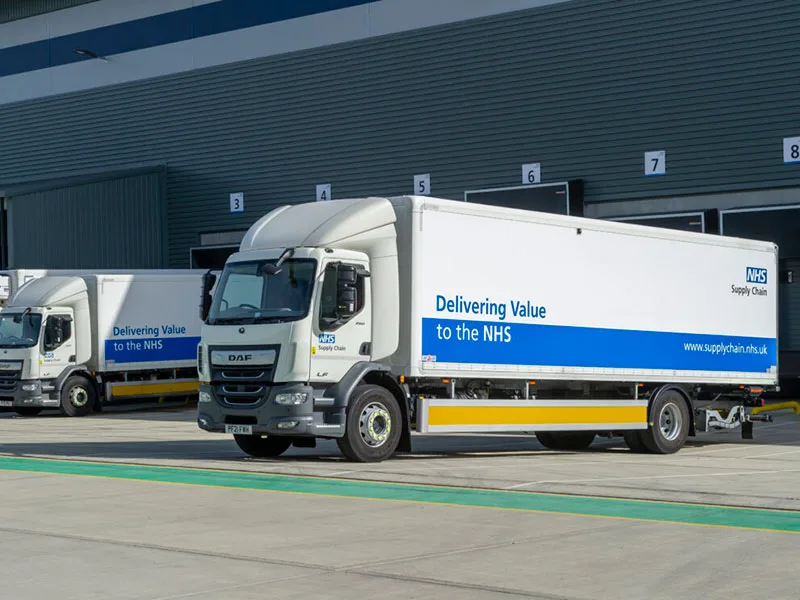
How Dynamon helped NHS Supply Chain understand the feasibility of electrifying its 18-tonne hospital logistics fleet in Wales. Using Quartix telematics in ZERO, Dynamon’s decarbonisation analysis team assessed whether market-ready 19-tonne electric trucks — including products from MAGTEC and DAF — could replace diesel operations serving hospitals in the north and south of Wales, and what charging infrastructure would be required at Green Vale, Denbigh and Bridgend.
In partnership with


Key outcomes
- 95% of routes could be completed with 19-tonne electric trucks at both 22 kW and 150 kW charging — showing dwell time, not charger power, was the decisive factor.
- 15 regular routes remained unsuitable for EVs due to long journey distances and should continue on diesel, while the rest of the operation can electrify with confidence.
- Limited payload impact — the one-tonne weight derogation (18-tonne diesel to 19-tonne electric) means electrifying these operations has limited implications for payload.
- Right-sized infrastructure — site-level energy demand and charging schedules for Green Vale, Denbigh and Bridgend, avoiding unnecessary spend on the highest-power chargers.
The challenge
NHS Supply Chain needed to know whether its 18-tonne diesel operation — replenishing laundry and other supplies to hospitals across north and south Wales — could move to electric vehicles already available on the market, and what depot charging those operations would require.
Vehicles operate from distribution centres across Wales to serve hospitals in both regions. The duty cycles are operationally critical: hospital supply must remain reliable, while electrification decisions have to account for real-world factors such as tail-lift use and payload.
The question was not only whether the latest 19-tonne EV products could complete the work, but also which routes should transition first, what charging power was needed at each depot, and whether higher-power chargers would deliver a meaningful return given how the fleet actually dwells between shifts.
The approach
Historical telematics data was collected from NHS Supply Chain’s telematics provider, Quartix, and analysed in ZERO — Dynamon’s whole-fleet decarbonisation analysis and planning software.
Dynamon’s decarbonisation analysis team ran a full vehicle feasibility study for the 18-tonne operation, testing market-ready 19-tonne electric trucks from MAGTEC and other OEMs including DAF. The analysis modelled charging at 22 kW and 150 kW, planned infrastructure requirements at Green Vale, Denbigh and Bridgend, and accounted for auxiliary power draw from the tail lift so that EV performance reflected real-world hospital logistics shifts.
Because the UK allows a one-tonne weight derogation for electric goods vehicles — moving from 18 tonnes on diesel to 19 tonnes on electric — the study also considered payload implications. That derogation means electrifying these operations has limited impact on the payload available for laundry and hospital supplies.
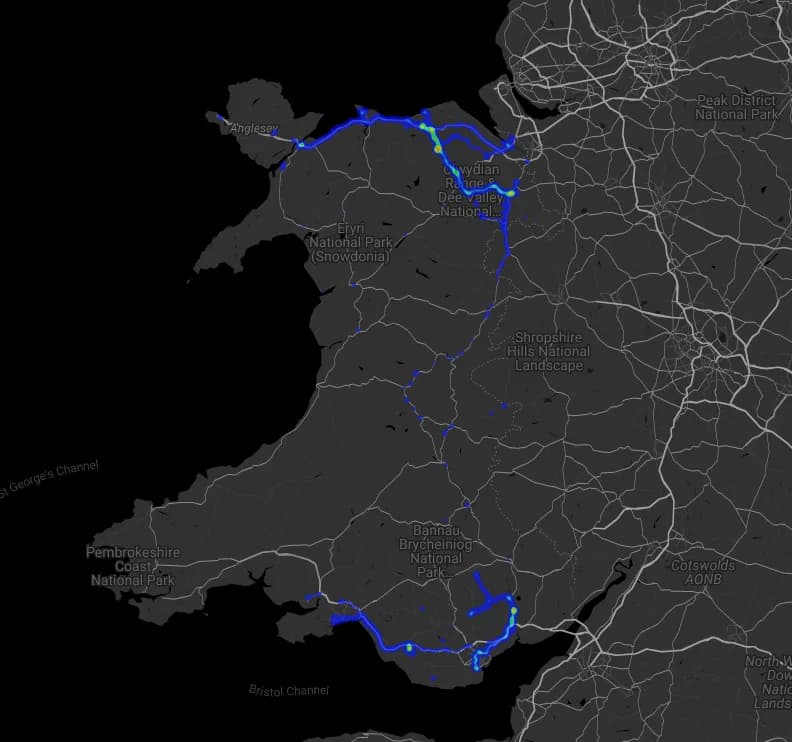
Wales operations from Quartix telematics
ZERO mapped Quartix telematics across Wales, showing concentrated activity along the north Wales coast and the south Wales M4 corridor, with connector routes linking the two regions. Distribution centres at Green Vale, Denbigh and Bridgend sit within those activity clusters, serving hospitals across both north and south Wales.
The heat map confirmed that most work is regional and hub-based rather than continuous multi-shift trunking — a pattern that favours depot charging between shifts, provided journey distances stay within EV capability.
Vehicle feasibility: 22 kW vs 150 kW
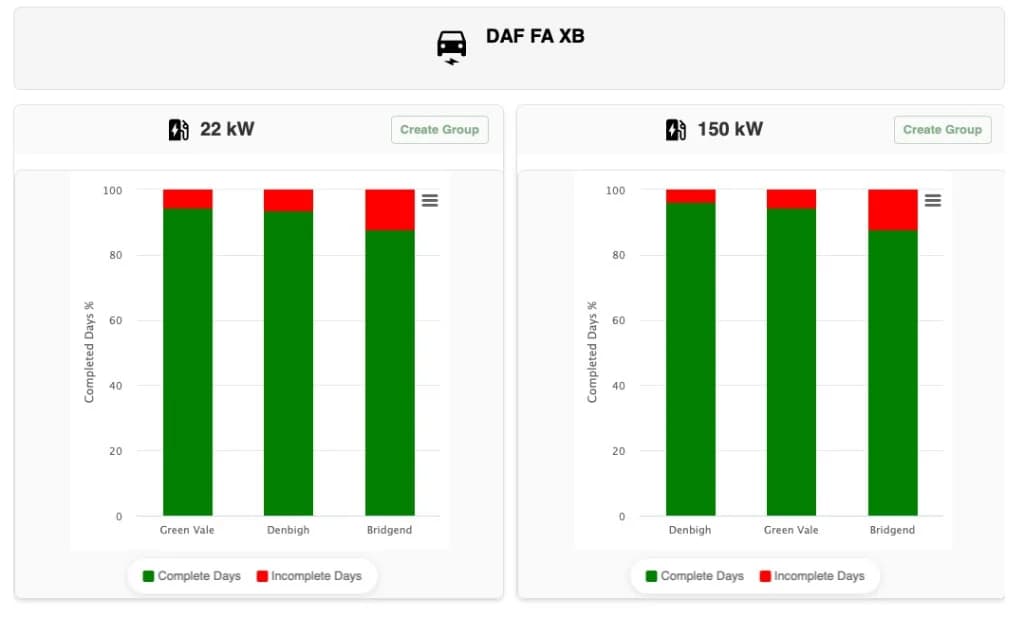
ZERO modelled 19-tonne electric trucks — including DAF products — against real duty cycles at Green Vale, Denbigh and Bridgend, comparing completed-day feasibility at 22 kW and 150 kW charging.
Across the operation, around 95% of routes could be completed at both 22 kW and 150 kW. The near-identical results show that dwell time at the depots was sufficient to recharge between shifts: these vehicles are not running multi-shift operations that would force a step up to the highest available charger power.
Fifteen regular routes could not be completed because of long journey distances. Those routes are best left on diesel for now, while the remainder of the operation can electrify with confidence. The principle is the same as on other ZERO studies: transition the work that EVs can do reliably, and keep a clear view of the residual diesel requirement.
Energy demand and charging schedule
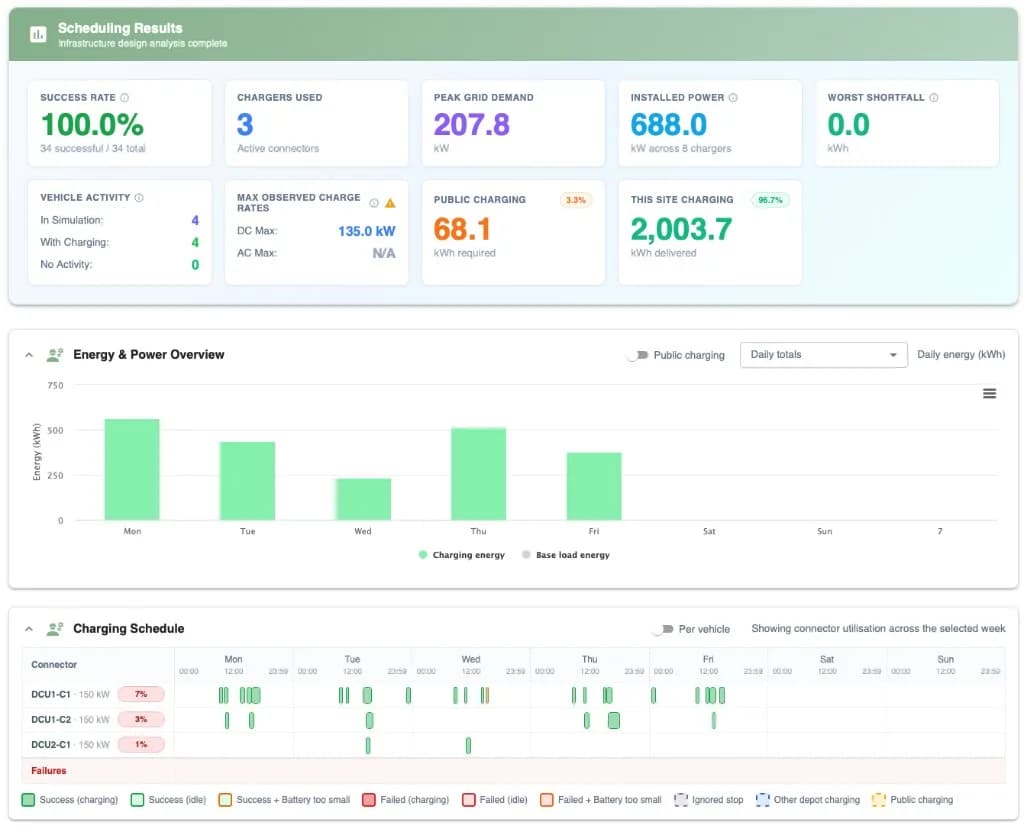
With vehicle feasibility understood, Dynamon produced site-level energy demand predictions to inform grid capacity and charger specification. ZERO profiled daily charging energy and connector utilisation, showing how depot dwell could be used to meet demand without oversizing installed power.
The schedules reinforce the feasibility finding: utilisation on high-power connectors remains modest when dwell times are healthy. That gives NHS Supply Chain confidence to right-size infrastructure — investing where it is needed, without defaulting to the highest-power chargers available.
The results
NHS Supply Chain now has a clear, evidence-based view of where its 18-tonne Welsh hospital logistics operation can electrify today — grounded in Quartix telematics and structured through ZERO.
Around 95% of routes are feasible on 19-tonne electric trucks with either 22 kW or 150 kW charging, while 15 long-distance regular routes should remain on diesel. The one-tonne electric weight derogation limits payload impact, and modelling tail-lift auxiliary load keeps the feasibility results realistic for hospital supply shifts.
Site-level energy profiling for Green Vale, Denbigh and Bridgend gives an infrastructure specification that matches how the fleet actually operates — supporting electrification without unnecessary spend on charger power.
From Quartix telematics to vehicle feasibility, right-sized charging and depot energy demand, Dynamon and ZERO helped NHS Supply Chain turn a complex electrification question into a practical plan for hospital logistics across Wales.