
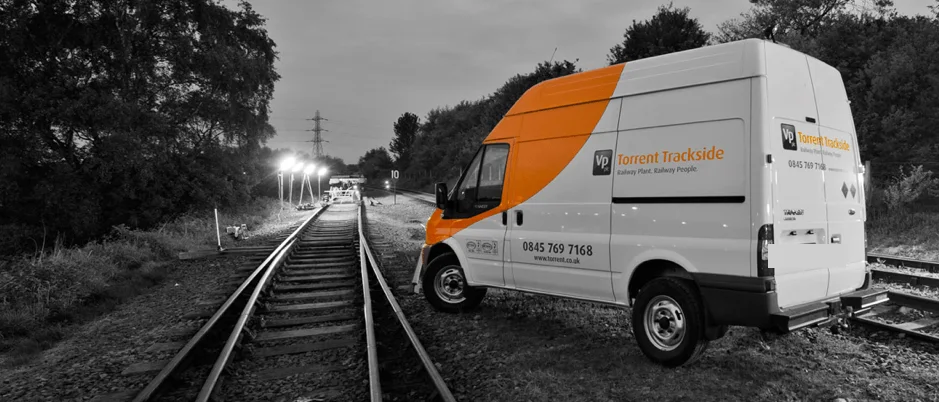
Torrent Trackside supplies portable rail plant and trackside services across the UK. Part of Vp plc, it supports Network Rail, London Underground and their contractors from a network of depots, and with engineers who take their vans home. Dynamon used ZERO to replay three months of Geotab telematics and test which electric vans could cover that work, and whether charging belonged at the depot, at home, or both.
Customer

Key outcomes
- 91 vans of Geotab telematics, from September to November 2023, across a fleet list of 103 vehicles at 8 depots and in 4 home-based regions.
- Faster depot charging changed little. Moving from 7 kW to 50 kW barely raised how many days an electric van could finish, because the vans spend so long away from the depot.
- 7 kW at home changed the result. With a Mercedes eSprinter, Treforest completed 94% of driving days, Glasgow 86% and Lichfield 79%. The home-based regions completed 90% or more.
- 124.5 kW was the existing site fuse, and it was enough for the charging recommended at every depot.
The challenge
A rail support van does not sit in the yard between jobs. It drives to a worksite, stays for hours, and much of the fleet parks overnight at an engineer’s home rather than at one of the eight depots. A charger on the depot only helps for the hours the van is actually there.
Torrent Trackside needed that pattern from the fleet’s own Geotab telematics before a battery or a charger was specified.
The approach
Dynamon registered the eight depots in ZERO and drew a geofence around each site, so the telematics could show when a van arrived and when it left. The fleet list held 103 vehicles: 98 diesel vans, 3 already electric, and 2 unassigned. The study analysed the diesel vans. Geotab telematics covered 91 of them from September to November 2023, sampled about every 11 seconds.
Three electric vans were compared: a Peugeot e-Boxer with 68 kWh usable, a Ford E-Transit at 68 kWh, and a Mercedes eSprinter at 113 kWh. The model assumed a full payload and a 1.4 kW auxiliary load. The first run gave the depots 7 kW, 11 kW and 50 kW chargers, and no charging at home.
That run showed the limit was not the speed of the depot charger. Raising power to 50 kW barely changed how many driving days were completed. The vans were away from the depot for too long, or the duty cycle was longer than a depot-only charge could cover. Some vans listed as depot-based were parking overnight at home, and most of the fleet spent long stops off site, at a job or at home.
The second run gave every van a 7 kW charger at home as well as charging at the depot, and tested the duty cycles in harsh conditions so the recommendation would still hold in poor weather. Across the fleet the average duty cycle was 81 miles. In those harsh conditions ZERO estimated 157 miles of range for the eSprinter, against a combined WLTP figure of 249 miles.

The results
With a Mercedes eSprinter, a 7 kW depot charger and a 7 kW home charger, the share of driving days completed was 94% at Treforest, 86% at Glasgow and 79% at Lichfield. Across the four home-based regions it was 90% or higher: 95% in the East, 94% in the North, 90% in the South and 96% in the West. On that setup, more than 90% of the home-based fleet can move to electric with a 7 kW charger where the van parks overnight.
Ashford and Bristol stayed harder. On the same van and the same 7 kW chargers they completed 53% and 49% of days. Bristol’s duty cycles averaged 148 miles. A smaller battery did less of the work: at several depots the 68 kWh vans finished noticeably fewer days than the 113 kWh eSprinter.
Romford showed how much the overnight stop matters. Depot charging alone completed 19% of days. Home charging, together with a wider depot geofence so more of the recorded stops were counted, lifted that to 70%.
At the depots, the existing 124.5 kW site fuse was enough for the chargers recommended. A cost comparison of a diesel fleet, a fully electric fleet and a mixed rollout was also run. It did not include the cost of charging infrastructure. On that vehicle comparison the depots were suitable to transition, with Ashford and Bristol the exception, where part of the fleet was still cheaper as diesel.
Three months of van telematics, three battery sizes, and a test of depot charging against charging at home: that is what Dynamon prepared from the Geotab record so Torrent Trackside can specify electric vans, and the chargers, around the way the fleet already works.