
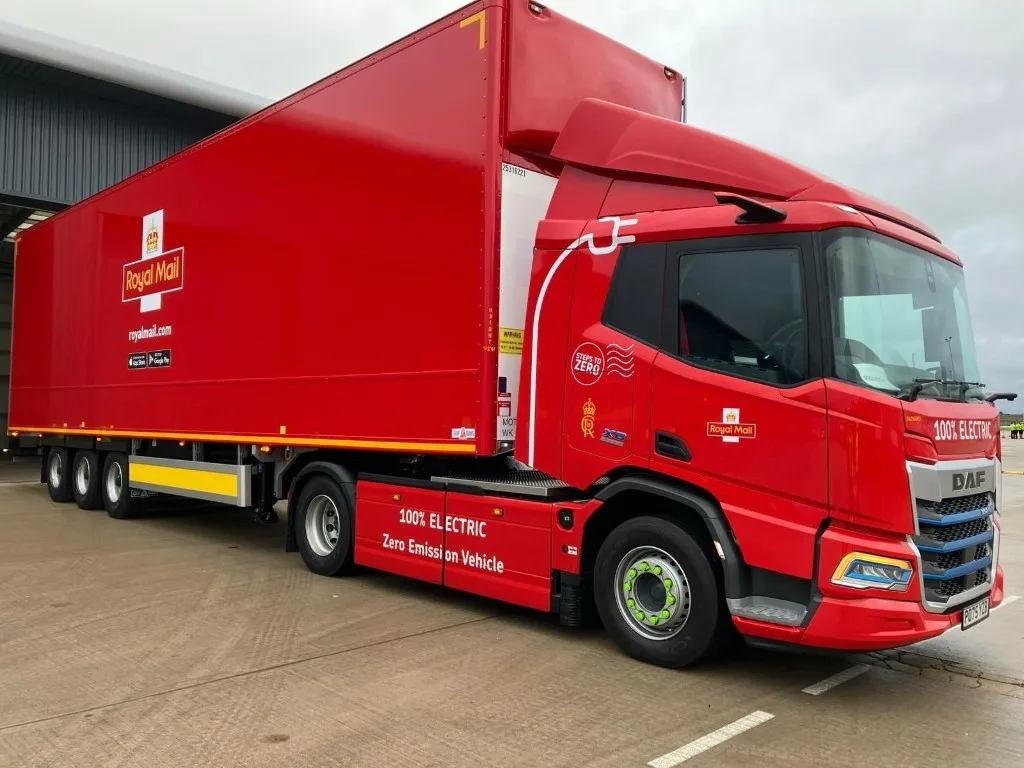
Using Dynamon’s ZERO platform and Synthetic Telematics, Royal Mail evaluated how trailer configuration affects the range and efficiency of battery electric HGVs. The analysis provided independent evidence to support vehicle selection, route planning and charging strategy before procurement.
Key outcomes
- OEM comparison — DAF, Scania and Renault electric tractor units compared
- 14–21% reduction in achievable range with double-deck trailers
- Duty cycles — representative urban and motorway Royal Mail operations simulated
- Up to 73% of motorway battery energy consumption attributed to aerodynamic drag
- Pre-procurement — vehicle specification and charging decisions supported before procurement
The challenge
Royal Mail wanted to understand how battery electric articulated HGVs would perform across its parcel delivery operation.
Double-deck trailers provide greater carrying capacity than single-deck trailers, but their additional height, weight and aerodynamic drag can reduce achievable range. Before investing in electric HGVs, Royal Mail needed an independent assessment of how different electric tractor and trailer combinations would perform across representative urban and motorway routes.
The solution
Using ZERO’s Synthetic Telematics capability, Dynamon recreated representative Royal Mail operations from the Princess Royal Distribution Centre.
The project modelled:
- Urban and motorway duty cycles
- Single-deck and double-deck trailer configurations
- Multiple battery capacities
- DAF, Scania and Renault electric tractor units
- Ideal and harsh weather conditions
For every scenario, ZERO predicted vehicle energy consumption, achievable range and the contribution of aerodynamic drag, rolling resistance, acceleration and auxiliary loads.
This enabled Royal Mail to compare multiple vehicle and trailer configurations without the cost, complexity and time required for physical vehicle trials.
The results
Across all three manufacturers, double-deck trailers consistently reduced achievable vehicle range.
On urban routes, range reductions were typically 14–16%.
On motorway routes, reductions increased to approximately 18–21%, primarily because aerodynamic drag has a much greater influence at sustained higher speeds.
The analysis also found that aerodynamic drag accounted for approximately:
- 28–37% of battery energy consumption during urban driving
- 63–73% during motorway driving
The study demonstrated that real-world motorway range can be significantly lower than manufacturer-stated figures depending on trailer type, payload, weather and operating conditions.
The outcome
The project gave Royal Mail an independent, data-driven understanding of the trade-off between carrying capacity and vehicle range.
Using ZERO, Royal Mail was able to compare multiple electric HGV platforms, assess the impact of trailer choice and make informed decisions around vehicle specification, route suitability and charging requirements before committing to procurement.
The project demonstrates how high-fidelity simulation can reduce the cost, risk and complexity of fleet electrification by identifying operational constraints before vehicles are deployed.