
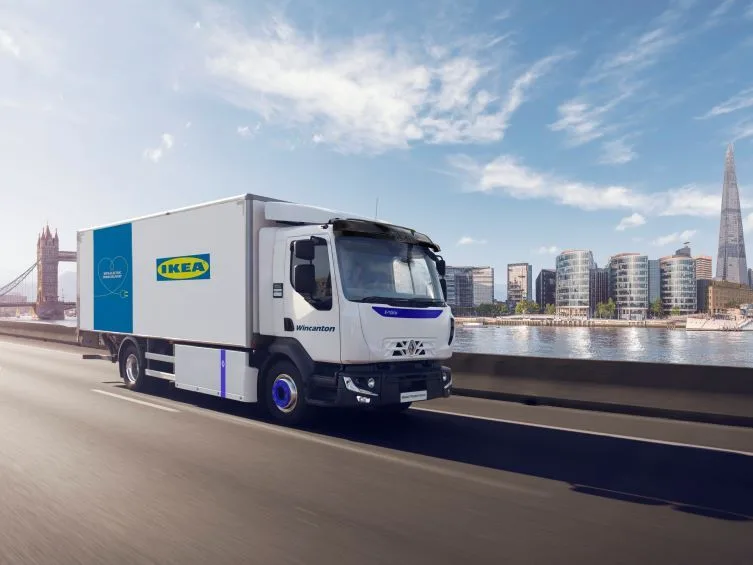
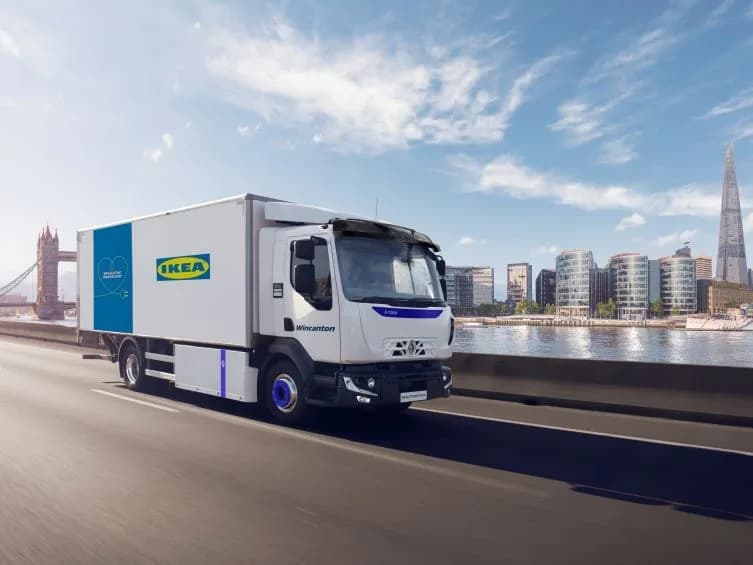
How Dynamon helped Wincanton — now part of GXO — plan electrification of IKEA’s large-item home delivery operation from Harlow. In 2023, one of Wincanton’s first fleet electrification studies with Dynamon used ZERO and high-resolution Powerfleet telematics to assess vehicle feasibility, design depot charging within grid constraints, and give IKEA a clear path to cut Scope 3 emissions into London.
In partnership with



Key outcomes
- 94% feasible at Harlow with 22 kW charging — only a small share of journeys each week were too long or demanding for the EV products assessed.
- 10 of 11 vehicles suitable for electrification, with one diesel retained for the harder journeys that EVs could not complete reliably.
- Right-sized infrastructure — depot charging design that accounted for dwell time, peak grid demand and energy delivery, without oversizing installed power.
- Investment decision — evidence that informed Wincanton’s multimillion-pound EV investment for IKEA home delivery across Greater London and the Southeast.
The challenge
Wincanton operated IKEA’s large-item home delivery service from the Harlow Distribution Centre, covering the north half of London and surrounding home counties. The duty cycle was demanding urban and suburban delivery work on 12-tonne diesel vehicles — exactly the kind of last-mile operation where electrification can cut carbon, but only if vehicles and charging are matched to real journeys.
IKEA needed a credible path to reduce Scope 3 emissions from home delivery into London. Wincanton needed evidence before committing capital: which vehicles could switch to electric, which journeys should stay on diesel, what charging power Harlow could support given grid limitations, and whether dwell time at the site would make the energy demand work in practice.
This was one of the first decarbonisation and fleet electrification analyses Dynamon delivered for Wincanton in 2023 — a foundational study that had to turn telematics into a precise electrification plan both partners could act on.
The approach
Dynamon was chosen as the analysis partner, using ZERO — Dynamon’s whole-fleet decarbonisation analysis and planning software — linked to Wincanton’s telematics provider, Powerfleet, to process a high-resolution operational dataset.
The study combined vehicle feasibility with site infrastructure design. ZERO modelled whether market-ready electric products could complete the 12-tonne Harlow duty cycles, then designed charging at the depot to reflect real dwell patterns, peak grid demand and daily energy requirements — so the plan was constrained by the grid as well as by the vehicles.
That dual view — which work can electrify, and what the site must install to support it — gave Wincanton and IKEA a shared evidence base for investment, rather than a high-level ambition alone.
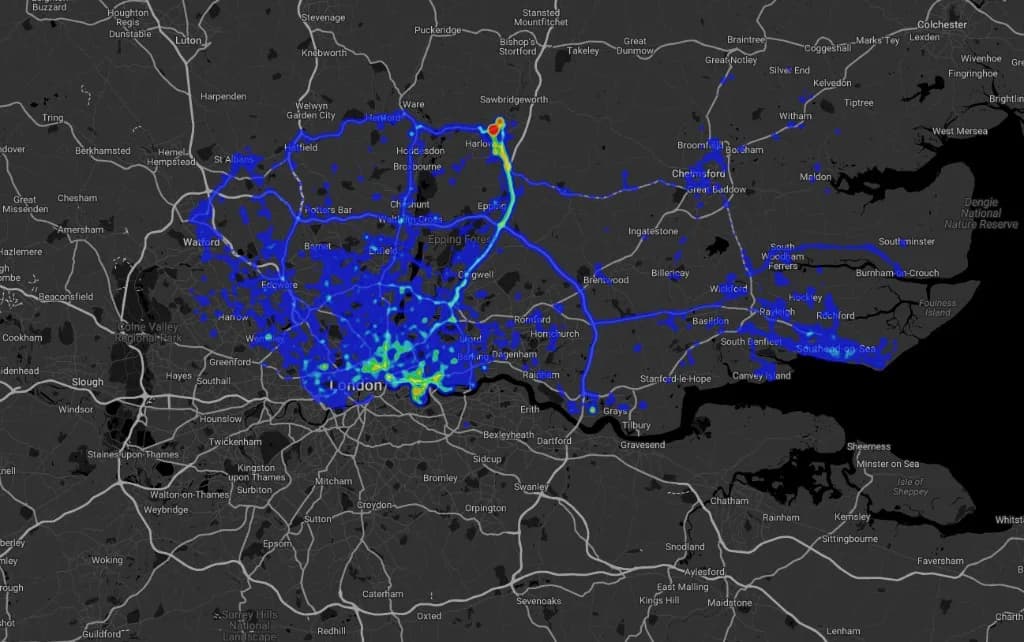
Harlow operations from Powerfleet telematics
ZERO mapped Powerfleet telematics across Greater London and the surrounding counties, showing a clear origin at Harlow north of the M25 and a dense corridor of activity south into north London.
Coverage concentrated north of the Thames — Enfield, Barnet, Harrow and neighbouring boroughs — with routes also reaching east into Essex and west towards Watford, St Albans and Hemel Hempstead. Activity dropped sharply south of the river, confirming this as a north-London–focused large-item delivery network rather than a pan-London trunking operation.
That geographic pattern mattered for electrification: depot-return work with substantial overnight dwell at Harlow favoured site charging, provided journey distances and energy demand stayed within EV capability for most vehicles.
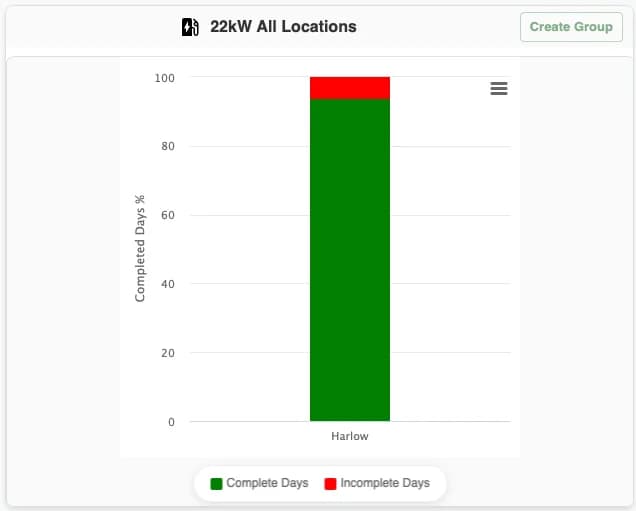
Vehicle feasibility at 22 kW
ZERO assessed completed-day feasibility for the Harlow 12-tonne operation with 22 kW charging. Across all locations in the analysis, around 94% of operational days could be completed by the electric products modelled — meaning the large majority of journeys were within EV capability when vehicles returned to charge at the depot.
The residual incomplete days — roughly 6% — corresponded to journeys that were too long or too demanding for the EV products assessed. Those harder trips are the ones that should remain on diesel in the near term, rather than forcing an EV into work it cannot finish reliably.
Which vehicles to electrify first
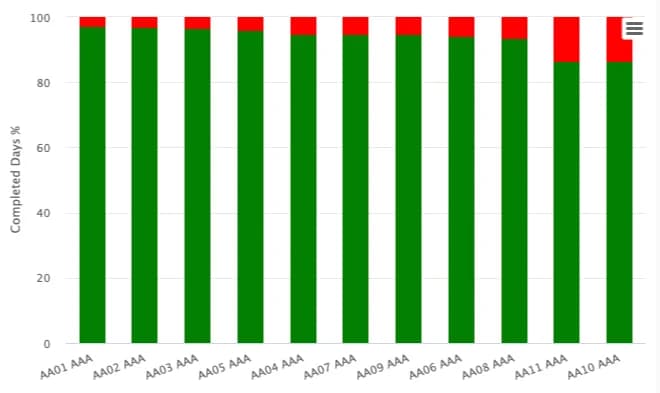
Drilling into the eleven 12-tonne vehicles showed that feasibility was not uniform. Most vehicles completed around 94–97% of days on the EV products modelled; two vehicles with a higher share of harder journeys sat closer to 86–87%.
That vehicle-level view supported a practical transition plan: electrify ten of the eleven vehicles, and retain one diesel to cover the residual hard journeys each week. IKEA still gains substantial CO₂ reduction on the electrified majority of the London operation, without pretending every last journey is EV-ready on day one.
Infrastructure design and grid demand
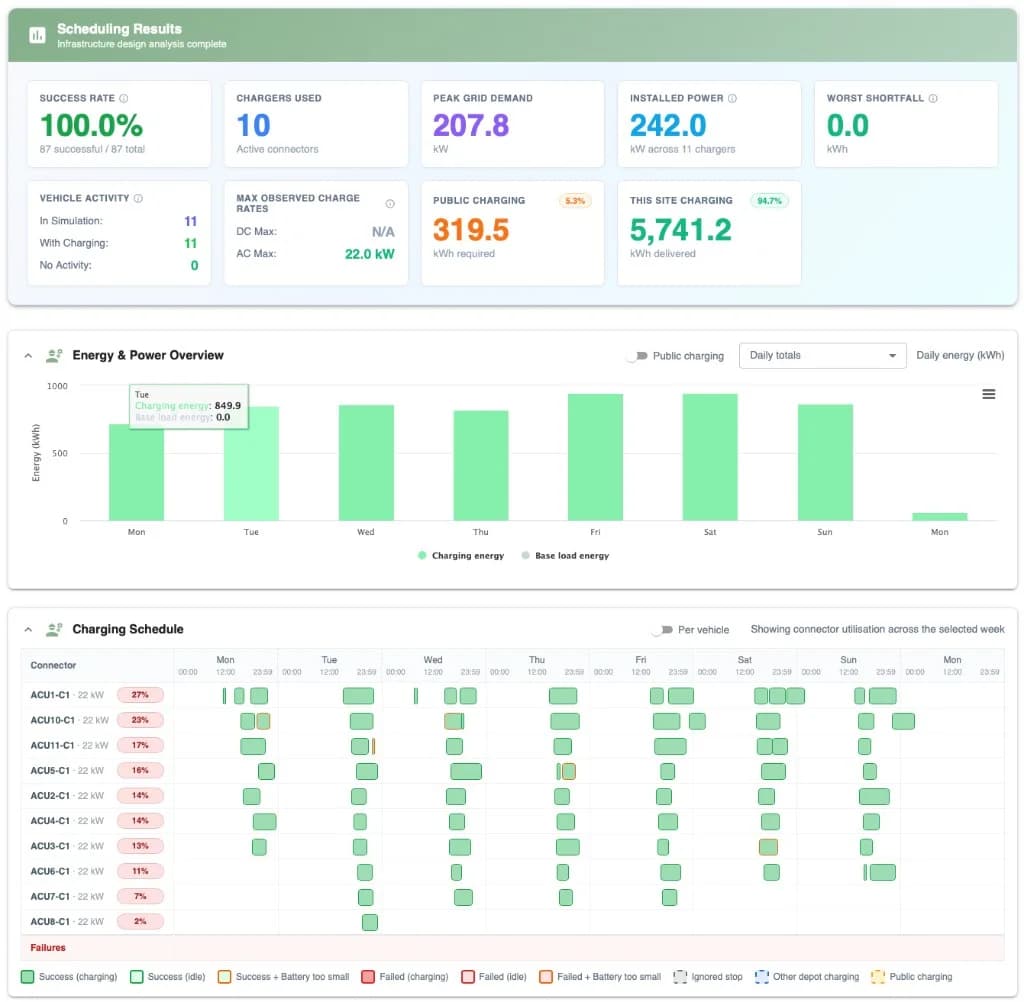
Vehicle feasibility alone is not enough if the depot cannot charge the fleet within available grid capacity and real dwell windows. ZERO’s infrastructure design for Harlow modelled connector utilisation, daily energy demand and peak power — taking dwell time into account so charging power was sized to how vehicles actually return between shifts.
For the modelled week, a design with ten 22 kW AC chargers achieved a 100% journey success rate, with peak grid demand around 208 kW against roughly 242 kW of installed power. Around 95% of charging energy was delivered at the site, with only a small share relying on public charging.
Worst shortfall was zero in the modelled schedule — evidence that, with right-sized 22 kW infrastructure and the dwell available at Harlow, energy demand need not breach a carefully planned grid envelope. That gave Wincanton confidence to invest in charging that matched the operation, rather than defaulting to higher-power hardware the duty cycle did not require.
The results
Wincanton and IKEA left the study with a precise electrification plan for Harlow: around 94% of the operation feasible on electric, ten of eleven vehicles ready to transition, one diesel retained for harder journeys, and a 22 kW depot charging design that respected dwell time and grid limits.
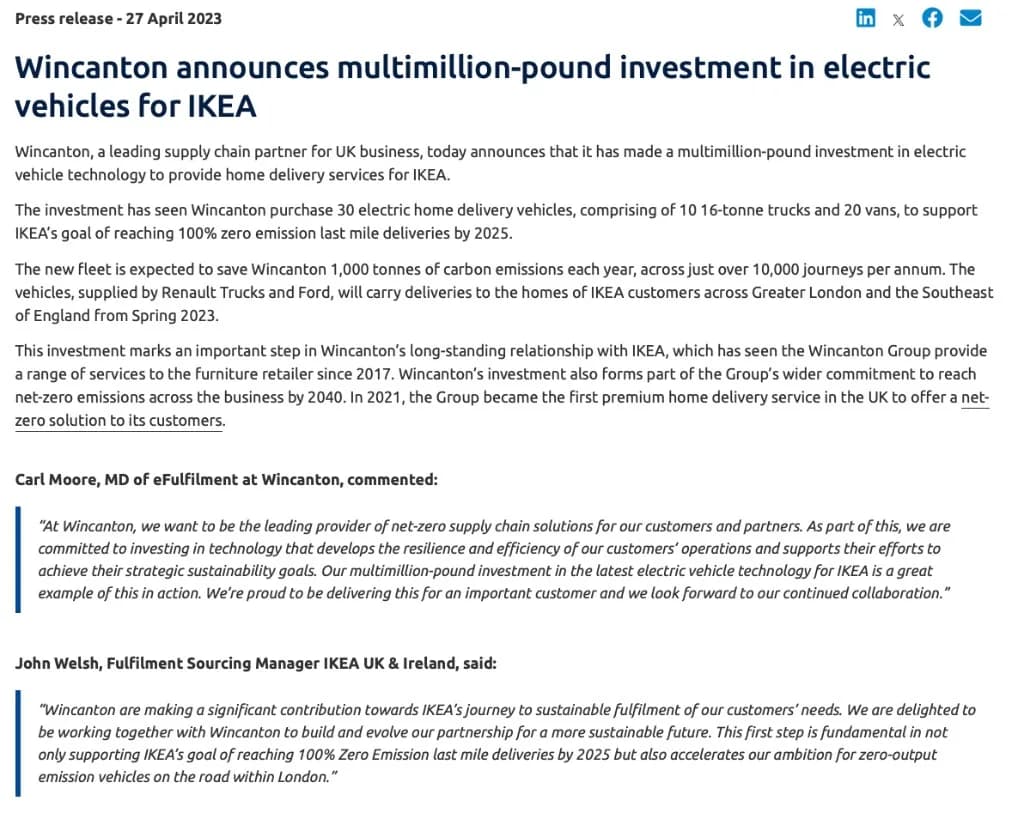
That evidence helped inform Wincanton’s multimillion-pound investment in electric vehicles for IKEA home delivery — announced in April 2023 — supporting IKEA’s ambition for zero-emission last-mile deliveries and Wincanton’s wider net-zero commitments. For IKEA, electrifying this London large-item operation delivered a meaningful reduction in Scope 3 emissions from home delivery.
As one of Wincanton’s first Dynamon ZERO electrification studies, Harlow showed how linking Powerfleet telematics to whole-fleet analysis turns a complex depot question into a decision both the logistics partner and the retailer can stand behind.
From Powerfleet telematics to vehicle feasibility, right-sized 22 kW charging and a clear residual diesel plan, Dynamon and ZERO helped Wincanton (now GXO) and IKEA turn Harlow’s large-item home delivery operation into an evidence-based electrification investment.