
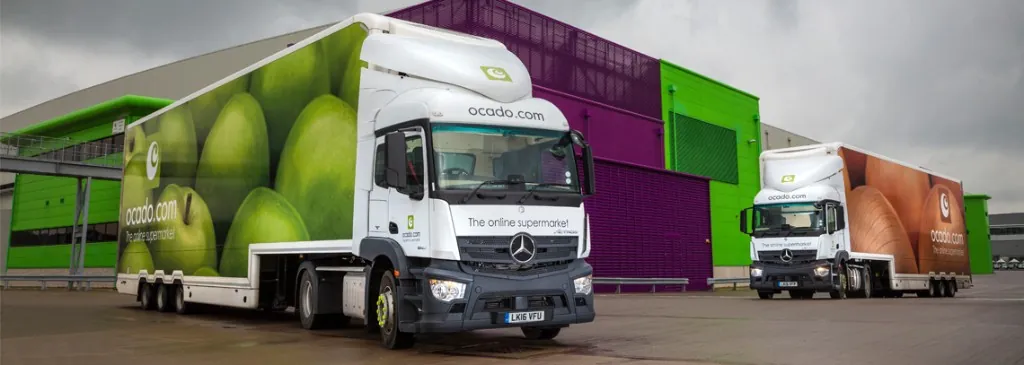
Ocado’s heavy goods vehicles do one job, the same way every day: from a customer fulfilment centre out to a run of spokes, then back. For twelve months Dynamon analysed that trunking fleet, through a direct connection to Fleetboard, to show where further fuel savings would come from.

Key outcomes
- 3% fuel saving identified from reducing trailer weight. Fully loaded, the vehicles are still under the legal gross weight, so the saving is fuel, not extra cargo.
- 2.5% from further aerodynamic optimisation, on a fleet that already runs tall double-deck trailers shaped for motorway work.
- 3% from improved tyre choice. Ocado wanted to take that question further, alongside other ideas for cost and CO₂.
“We were aware of the merits of reducing weight to increase payload, however the fuel saving potential was something we hadn’t considered before Dynamon demonstrated this to us. We would also like to use Dynamon to explore other cost and CO₂ saving opportunities such as optimising our tyre choice.”
Stuart Skingsley, Head of Fleet, Ocado
The fleet
Ocado is an online supermarket. Groceries are picked and packed at customer fulfilment centres and taken by heavy goods vehicle to spoke sites, where they move onto a van for delivery. This study is that trunking fleet. The vans that finish the round are a different operation, of the kind covered for other grocers in Sainsbury’s Bristol fulfilment centre and Asda’s home-delivery fleet.
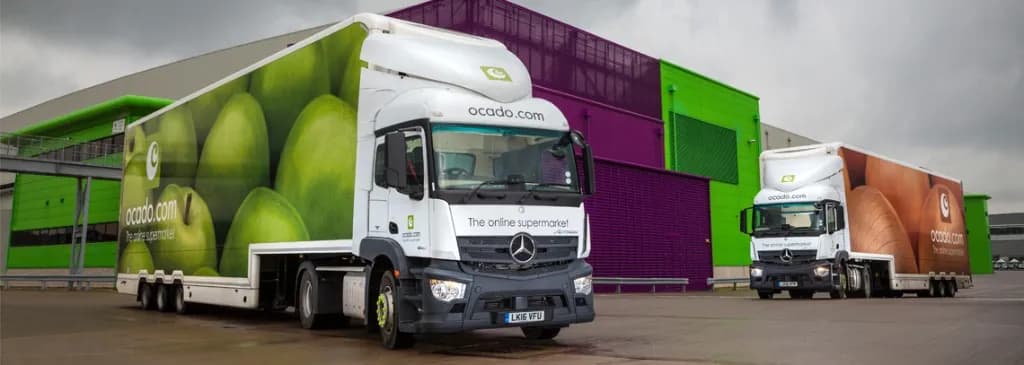
The tractor units pull ambient and refrigerated trailers. Most are double-deck, built to the maximum height so each journey carries as much as it can, and supplied by Paneltex. Single-deck trailers cover the routes with a height restriction. The hubs and spokes sit on motorways and major roads, so the vehicles spend most of their time at speed, with little stop-start. The journeys are set in advance and they barely change. That consistency is what let Ocado specify the vehicles for this work alone, including a more aerodynamic double-deck trailer.
The approach
Dynamon connected directly to Ocado’s Fleetboard telematics and collected the configuration and dimensions of the vehicles. The algorithms split fuel consumption into its causes, so a saving is tied to the change that would produce it.
Putting a number on an aerodynamic change, or on a different tyre, is what Aero Analytics and Tyre Analytics do for a fleet like this.
Where the savings are
Three changes stood out. Reducing trailer weight offered a 3% fuel saving. Further aerodynamic optimisation offered 2.5%. A better choice of tyre offered 3%.
Ocado looked hardest at the weight. A fleet usually cuts weight so it can carry more within the legal gross limit. These vehicles, fully loaded, are still under that limit. There is no extra payload to unlock. There is still fuel to save: less weight on the tyres means less rolling resistance and less tyre wear, and less weight takes less energy to accelerate and to climb. That energy is not handed back on the way down. Ocado is identifying where the excess weight can come off the trailers.
The fleet was already built around one duty: consistent, high-speed trunking in tall double-deck trailers. The next savings are in the trailer itself — its weight, its shape, and the tyres under it — and the weight is where Ocado started.